Introduction
Marketing Automation has become an essential strategy for businesses looking to streamline customer interactions and improve operational efficiency. As companies grow, managing customer communications manually becomes increasingly difficult. Responding to every inquiry, sending follow-up emails, tracking leads, updating customer records, and nurturing prospects can consume significant time and resources. By automating these repetitive tasks, businesses can save time, reduce human error, and deliver personalized experiences at scale. This is where Marketing Automation becomes a powerful solution, enabling organizations to nurture leads more effectively, strengthen customer relationships, and drive sustainable business growth.
Marketing automation uses software and technology to automate repetitive marketing tasks while delivering personalized experiences to customers. Instead of manually sending emails or following up with every lead, businesses can create automated workflows that communicate with customers at the right time and through the right channels.
From lead nurturing and email campaigns to WhatsApp messaging, CRM updates, and customer follow-ups, marketing automation helps businesses improve efficiency, generate more qualified leads, and strengthen customer relationships. In this article, you’ll learn what marketing automation is, its benefits, key applications, popular tools, and best practices for implementing a successful automation strategy.
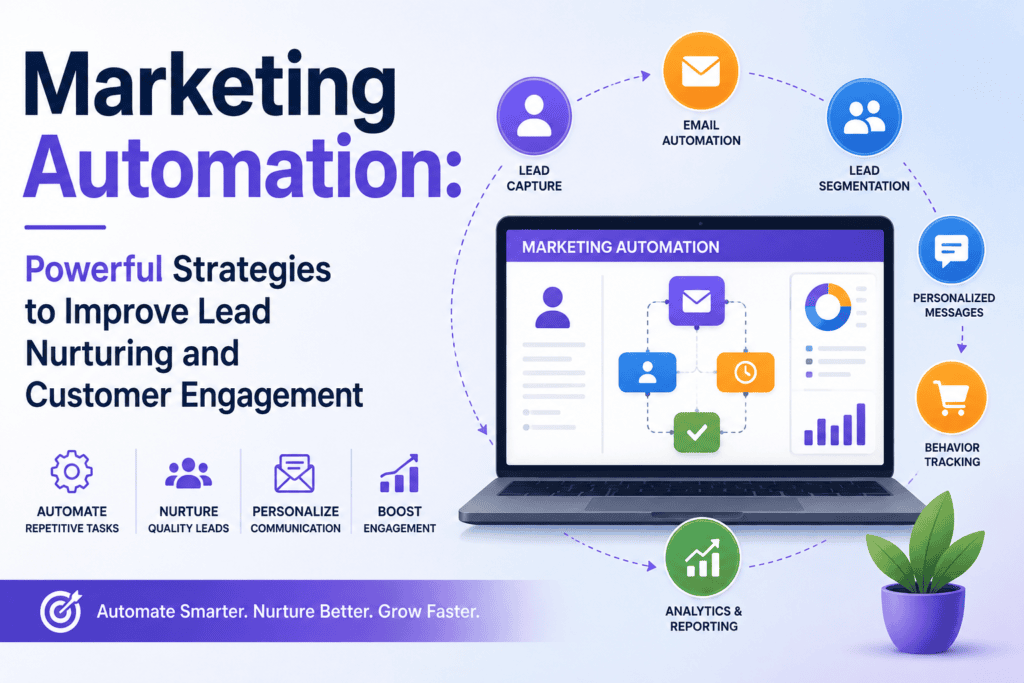
What Is Marketing Automation?
Marketing automation is the use of software to automate repetitive marketing activities based on customer behavior, preferences, and predefined rules.
Rather than performing every task manually, businesses create workflows that automatically send messages, assign leads, update customer records, and trigger actions whenever specific conditions are met.
For example, when someone downloads a free ebook from your website, an automation workflow can:
- Send a welcome email.
- Deliver the ebook instantly.
- Add the person to your CRM.
- Schedule a follow-up email after three days.
- Notify your sales team if the lead shows buying intent.
This entire process happens automatically without manual intervention.
Why Marketing Automation Is Important
Marketing automation offers numerous benefits for businesses of all sizes.
Saves Time
Automation eliminates repetitive tasks such as sending emails, updating customer records, and scheduling follow-ups.
This allows marketing and sales teams to focus on strategy, customer relationships, and business growth.
Improves Lead Nurturing
Not every lead is ready to buy immediately.
Automation keeps prospects engaged by delivering relevant content over time until they are ready to make a purchase.
Increases Personalization
Modern automation platforms personalize communication based on customer behavior.
Businesses can send different messages depending on:
- Website visits
- Products viewed
- Purchase history
- Email engagement
- Geographic location
Personalized communication improves customer engagement and conversion rates.
Boosts Sales
Timely follow-ups and personalized messaging increase the likelihood of converting leads into customers.
Businesses that consistently nurture leads often generate higher sales than those relying solely on manual communication.
Improves Customer Experience
Customers appreciate receiving relevant information at the right time.
Automation ensures consistent communication throughout the customer journey without overwhelming customers with unnecessary messages.
Automating Lead Nurturing
Lead nurturing is one of the most valuable uses of marketing automation.
Many website visitors need time before making a purchasing decision.
Automation allows businesses to educate and guide prospects throughout the buying process.
A typical lead nurturing sequence might include:
- Welcome email
- Educational blog articles
- Customer success stories
- Product demonstrations
- Frequently Asked Questions
- Limited-time offers
- Consultation invitations
Each message builds trust while moving prospects closer to becoming customers.
Automating Email Sequences
Email marketing remains one of the highest-performing digital marketing channels.
Automation allows businesses to create email sequences that trigger automatically.
Popular email workflows include:
Welcome Series
Sent immediately after someone subscribes.
These emails introduce the business and explain what subscribers can expect.
Educational Campaigns
Provide useful information that helps prospects solve problems while demonstrating your expertise.
Educational content builds trust before asking customers to buy.
Promotional Campaigns
Automatically send product launches, seasonal offers, and special discounts to relevant customer segments.
Abandoned Cart Emails
If a customer leaves products in their shopping cart without completing a purchase, automated reminders encourage them to return and finish the checkout process.
Re-Engagement Campaigns
Businesses can automatically reconnect with inactive subscribers by sending personalized offers or valuable content.
Automating WhatsApp Messages
WhatsApp has become one of the most effective communication channels for businesses.
Automation allows companies to send timely messages while maintaining personalized customer interactions.
Common automated WhatsApp messages include:
- Appointment confirmations
- Order updates
- Shipping notifications
- Payment reminders
- Customer support responses
- Promotional offers
- Event reminders
- Feedback requests
Since WhatsApp messages often achieve high open rates, automation can significantly improve customer engagement.
CRM Workflow Automation
A Customer Relationship Management (CRM) system stores and manages customer information.
Marketing automation integrates closely with CRM platforms to streamline customer management.
Automated CRM workflows may include:
- Creating new contact records.
- Assigning leads to sales representatives.
- Updating lead status.
- Recording customer interactions.
- Scheduling follow-up tasks.
- Sending internal notifications.
- Tracking customer activity.
Automation ensures sales teams always have accurate and up-to-date customer information.
Customer Follow-Up Automation
Following up consistently is essential for building long-term customer relationships.
Automation helps businesses maintain communication after purchases.
Examples include:
Order Confirmation
Customers automatically receive confirmation after completing a purchase.
Shipping Updates
Businesses notify customers when products are shipped or delivered.
Review Requests
After customers receive their products or services, automation can request reviews or testimonials.
Positive reviews strengthen brand credibility.
Loyalty Programs
Automation rewards repeat customers through:
- Discount coupons
- Exclusive offers
- Birthday messages
- Anniversary rewards
- VIP promotions
These programs encourage customer retention.
Popular Marketing Automation Tools
Many software platforms help businesses automate marketing activities.
HubSpot
One of the most comprehensive marketing automation platforms.
Features include:
- CRM
- Email marketing
- Lead nurturing
- Landing pages
- Analytics
- Sales automation
Suitable for businesses of all sizes.
Mailchimp
Popular for email marketing automation.
Provides:
- Email campaigns
- Customer segmentation
- Automated workflows
- Audience management
Ideal for small businesses and growing companies.
ActiveCampaign
Known for advanced automation features.
Offers:
- CRM integration
- Email automation
- SMS marketing
- Lead scoring
- Customer journeys
Excellent for businesses requiring sophisticated workflows.
Zoho CRM
Combines CRM functionality with marketing automation.
Features include:
- Lead management
- Workflow automation
- Sales tracking
- Email integration
Well suited for small and medium-sized businesses.
Salesforce Marketing Cloud
Designed for larger organizations requiring enterprise-level marketing automation.
Supports:
- Multi-channel campaigns
- Customer journeys
- AI-powered personalization
- Advanced analytics
Brevo (formerly Sendinblue)
Provides affordable automation tools for:
- Email marketing
- SMS campaigns
- WhatsApp messaging
- CRM functionality
Popular among startups and small businesses.
Best Practices for Marketing Automation
Start with Clear Goals
Before creating workflows, define your objectives.
Examples include:
- Generate more leads.
- Increase sales.
- Improve customer retention.
- Reduce manual work.
- Increase email engagement.
Clear goals produce better automation strategies.
Segment Your Audience
Avoid sending identical messages to every customer.
Create audience segments based on:
- Interests
- Purchase history
- Website behavior
- Location
- Customer lifecycle stage
Personalized communication performs significantly better.
Keep Messages Human
Automation should not sound robotic.
Use natural language and conversational messaging that reflects your brand’s personality.
Customers appreciate authentic communication.
Monitor Performance
Regularly analyze metrics such as:
- Email open rates
- Click-through rates
- Conversion rates
- Lead quality
- Customer retention
- Revenue generated
Continuous optimization improves results over time.
Avoid Over-Automation
While automation saves time, excessive messaging can overwhelm customers.
Balance automated communication with genuine human interactions when appropriate.
Common Marketing Automation Mistakes
Many businesses reduce effectiveness by making avoidable mistakes.
Common errors include:
- Sending too many automated emails.
- Ignoring customer preferences.
- Using outdated customer data.
- Failing to test workflows.
- Neglecting personalization.
- Not monitoring campaign performance.
- Forgetting human customer support.
Automation should enhance—not replace—meaningful customer relationships.
The Future of Marketing Automation
Artificial intelligence is rapidly transforming marketing automation. AI-powered platforms can now predict customer behavior, generate personalized content, recommend products, optimize campaign timing, and automate conversations through chatbots and virtual assistants.
As businesses collect more first-party data, automation will become even more personalized and customer-centric. Future marketing strategies will increasingly rely on AI-driven insights, predictive analytics, and intelligent workflows to deliver the right message to the right customer at the right time.
Conclusion
Marketing automation has become an essential component of modern digital marketing. By automating lead nurturing, email sequences, WhatsApp messages, CRM workflows, and customer follow-ups, businesses can save time, improve efficiency, and create more personalized customer experiences.
However, successful automation is not simply about sending messages automatically. It requires thoughtful planning, audience segmentation, high-quality content, and continuous optimization. Businesses that combine automation with genuine customer care will build stronger relationships, increase conversions, and achieve sustainable long-term growth. As technology continues to evolve, marketing automation will play an even greater role in helping organizations deliver exceptional customer experiences while scaling their marketing efforts efficiently.
