Introduction
First-Party Data Marketing is becoming one of the most important strategies in modern digital marketing. As privacy regulations become stricter and third-party cookies are being phased out, businesses are focusing on collecting customer data directly through their own websites, email campaigns, and digital channels.
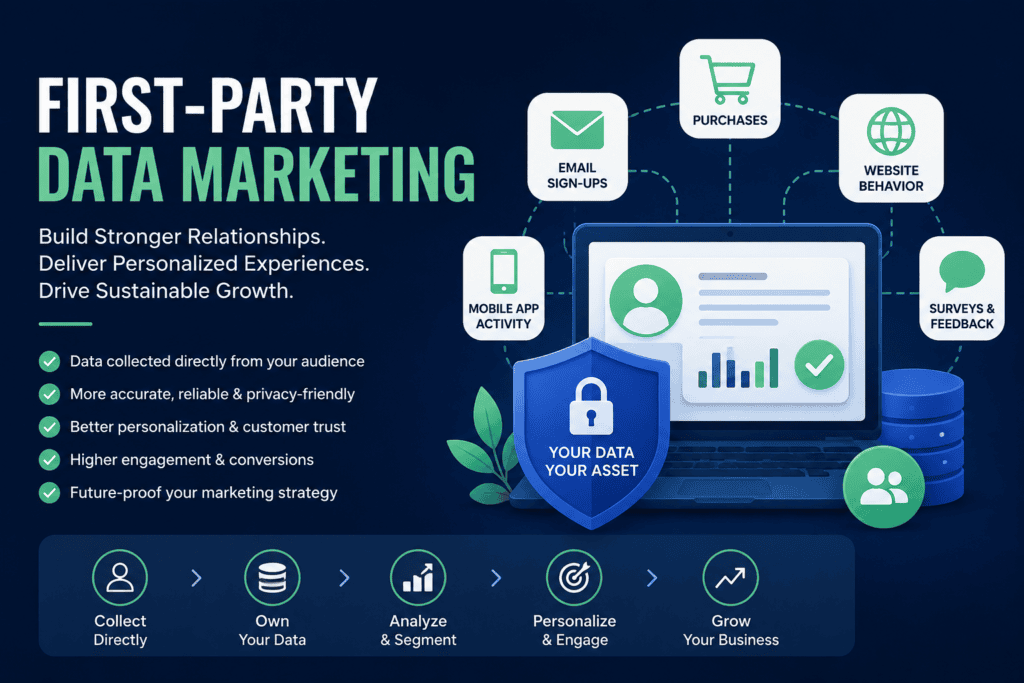
First-party data refers to information that a business collects directly from its own customers through interactions on its website, mobile app, social media, email campaigns, and other owned channels. Because this data is gathered with the user’s knowledge and consent, it is generally more accurate, trustworthy, and privacy-friendly than data obtained from external sources.
In this article, we’ll explore what First-Party Data Marketing is, why it matters, its benefits, practical collection methods, and best practices for using it effectively.
What Is First-Party Data Marketing?
First-party data marketing is information collected directly by a business from people who interact with its brand. Unlike third-party data, which is purchased from external providers, first-party data comes from your own customers and prospects.
Examples of first-party data include:
- Customer names and email addresses
- Phone numbers
- Purchase history
- Website browsing behavior
- Product preferences
- Customer feedback
- Survey responses
- Loyalty program information
- Email engagement metrics
- Mobile app activity
Since customers voluntarily share this information, it is usually more reliable and relevant for marketing purposes.
Why First-Party Data Is Becoming More Important
For many years, marketers relied on third-party cookies to track user behavior across different websites and deliver personalized advertisements. However, growing concerns about online privacy have led governments and technology companies to introduce stricter regulations and privacy-focused updates.
As a result:
- Third-party cookies are being phased out.
- Consumers expect greater transparency about data collection.
- Privacy laws require businesses to obtain user consent.
- Browsers increasingly limit cross-site tracking.
In this new environment, businesses that build strong first-party data strategies will be better positioned to understand their customers while respecting their privacy.
Benefits of First-Party Data Marketing
Higher Data Accuracy
Because first-party data comes directly from your customers, it is generally more accurate than information obtained from third-party providers.
Customers provide details about their preferences, purchases, and interests, allowing businesses to make better marketing decisions.
Improved Customer Personalization
Personalized marketing creates better customer experiences.
Using first-party data, businesses can:
- Recommend relevant products.
- Send personalized emails.
- Display customized website content.
- Offer targeted promotions.
- Improve customer support.
Customers are more likely to engage with marketing messages that match their interests and needs.
Stronger Customer Relationships
When customers willingly share their information, it creates opportunities for businesses to build trust and long-term relationships.
Rather than relying on anonymous tracking, companies can communicate directly with customers through email, loyalty programs, and personalized experiences.
This leads to higher customer satisfaction and stronger brand loyalty.
Better Marketing Performance
First-party data helps businesses improve the effectiveness of their marketing campaigns.
With accurate customer information, marketers can:
- Target the right audience.
- Reduce advertising waste.
- Improve conversion rates.
- Increase customer retention.
- Maximize return on investment (ROI).
More relevant marketing typically produces better results than broad, untargeted campaigns.
Compliance with Privacy Regulations
Many countries have introduced laws that regulate how businesses collect and use personal information.
By collecting data directly and obtaining proper consent, businesses are better prepared to comply with privacy regulations while maintaining customer trust.
How to Collect First-Party Data
Businesses can gather valuable first-party data through multiple channels.
Website Forms
Lead generation forms remain one of the simplest ways to collect customer information.
Examples include:
- Newsletter subscriptions
- Contact forms
- Free consultation requests
- Ebook downloads
- Webinar registrations
Offering valuable resources encourages users to share their information willingly.
Email Marketing
Email campaigns generate valuable engagement data.
Businesses can analyze:
- Open rates
- Click-through rates
- Subscription preferences
- Customer responses
- Purchase behavior after email campaigns
This information helps marketers create more personalized future campaigns.
Customer Accounts
Encouraging customers to create accounts allows businesses to collect useful information over time.
Customer accounts may include:
- Purchase history
- Saved products
- Wishlist items
- Shipping preferences
- Personal interests
This data improves the overall shopping experience.
Surveys and Feedback Forms
Customer surveys provide direct insight into customer opinions and preferences.
Businesses can ask about:
- Product satisfaction
- Service quality
- Future needs
- Feature requests
- Overall experience
These responses help improve products while strengthening customer relationships.
Loyalty Programs
Reward programs encourage customers to make repeat purchases while providing valuable behavioral data.
Businesses can learn:
- Purchase frequency
- Preferred products
- Average order value
- Customer lifetime value
This information supports personalized marketing and retention strategies.
Using First-Party Data in Marketing
Collecting data is only the first step. Businesses must also use it effectively.
Personalized Email Campaigns
Instead of sending identical emails to every subscriber, marketers can segment audiences based on:
- Purchase history
- Interests
- Geographic location
- Customer activity
- Product preferences
Personalized emails often generate higher open and conversion rates.
Product Recommendations
E-commerce businesses can recommend products based on previous purchases or browsing history.
Relevant recommendations increase customer satisfaction while boosting sales.
Audience Segmentation
Grouping customers into different categories allows businesses to deliver more relevant marketing messages.
Examples include:
- New customers
- Returning customers
- High-value customers
- Inactive customers
- Frequent buyers
Each segment receives content tailored to its specific needs.
Retargeting Existing Customers
Rather than focusing only on acquiring new customers, businesses can use first-party data to reconnect with existing customers.
Examples include:
- Reminder emails
- Product restock notifications
- Special discounts
- Birthday offers
- Loyalty rewards
Retaining existing customers is often more cost-effective than acquiring new ones.
Best Practices for First-Party Data Marketing
Be Transparent
Clearly explain:
- What data you collect.
- Why you collect it.
- How it will be used.
- How customers can manage their preferences.
Transparency builds trust.
Obtain Customer Consent
Always request permission before collecting personal information.
Customers should have control over their data and the ability to update or remove it when desired.
Prioritize Data Security
Protect customer information using:
- Secure websites (HTTPS)
- Encrypted databases
- Strong access controls
- Regular security updates
Protecting customer data is essential for maintaining trust.
Keep Data Updated
Outdated information reduces marketing effectiveness.
Regularly clean your database by:
- Removing inactive contacts.
- Updating customer preferences.
- Correcting inaccurate records.
Accurate data produces better marketing results.
Deliver Value in Exchange
Customers are more willing to share information when they receive something valuable.
Examples include:
- Free guides
- Exclusive discounts
- Educational webinars
- Personalized recommendations
- Loyalty rewards
Providing value creates a fair exchange between businesses and customers.
Common Mistakes to Avoid
Some businesses collect large amounts of customer data without using it effectively.
Avoid these common mistakes:
- Collecting unnecessary information.
- Ignoring customer privacy.
- Sending excessive marketing emails.
- Failing to update customer records.
- Using the same message for every audience.
- Neglecting data security.
Responsible data management leads to stronger customer relationships.
The Future of First-Party Data Marketing
As privacy regulations continue to evolve, first-party data will become increasingly important for businesses of all sizes.
Future marketing strategies will rely more heavily on:
- AI-powered personalization
- Customer data platforms (CDPs)
- Predictive analytics
- Marketing Automation
- Privacy-first technologies
Businesses that invest in ethical data collection and customer trust today will be better prepared for tomorrow’s digital landscape.
Conclusion
First-party data marketing is becoming the foundation of modern digital marketing in a privacy-focused world. By collecting information directly from customers through transparent and ethical methods, businesses can create more personalized experiences, improve marketing performance, and build stronger long-term relationships.
Rather than depending on third-party tracking, successful organizations are focusing on understanding their own audiences through meaningful interactions. When combined with strong data security, customer consent, and valuable content, first-party data becomes a powerful asset that benefits both businesses and customers.
As digital marketing continues to evolve, companies that prioritize trust, transparency, and customer-centric data strategies will be well-positioned for sustainable growth and long-term success.

Hi, this is a comment.
To get started with moderating, editing, and deleting comments, please visit the Comments screen in the dashboard.
Commenter avatars come from Gravatar.