Introduction
Conversion Rate Optimization (CRO) is the process of improving your website and landing pages to encourage more visitors to complete desired actions, such as filling out a contact form, subscribing to a newsletter, downloading an ebook, requesting a quote, or making a purchase. Rather than focusing solely on attracting more traffic, CRO helps businesses get more value from their existing visitors.
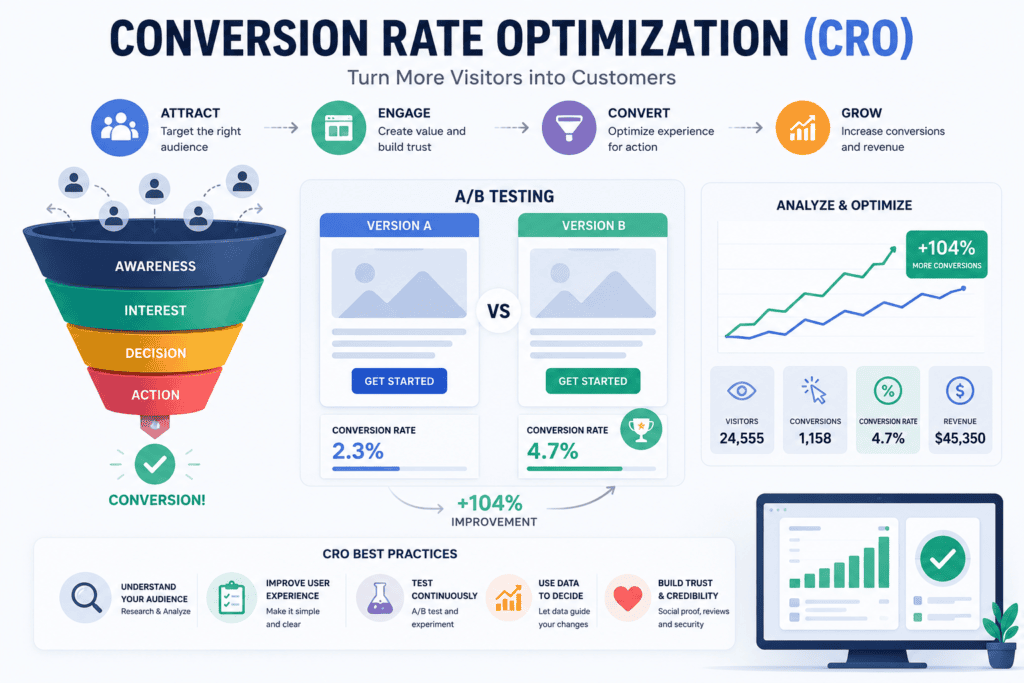
Driving traffic to your website is only half the battle in digital marketing. No matter how many visitors your website receives, your marketing efforts won’t generate meaningful results if those visitors don’t take action. This is where Conversion Rate Optimization (CRO) becomes essential.
Whether you run an e-commerce store, a local business, a SaaS company, or a service-based website, an effective CRO strategy can increase leads, sales, and revenue without increasing advertising costs. In this article, we’ll explore what CRO is, why it matters, landing page optimization techniques, A/B testing, and best practices for improving conversions.
What Is Conversion Rate Optimization (CRO)?
Conversion Rate Optimization (CRO) is the practice of improving a website so that a higher percentage of visitors complete a desired action, known as a conversion.
A conversion could include:
- Purchasing a product
- Filling out a contact form
- Booking an appointment
- Signing up for a newsletter
- Downloading a free resource
- Registering for a webinar
- Starting a free trial
The goal is to remove obstacles and make it as easy as possible for visitors to become customers or qualified leads.
Why Conversion Rate Optimization (CRO) Matters?
Many businesses focus heavily on increasing website traffic through SEO, paid advertising, or social media. While attracting visitors is important, increasing traffic alone doesn’t guarantee business growth.
CRO offers several benefits:
Increase Revenue Without More Traffic
Instead of spending more money on advertising, CRO helps convert a greater percentage of existing visitors into customers.
For example, if your website receives 10,000 visitors each month and your conversion rate increases from 2% to 4%, your conversions double without attracting additional traffic.
Lower Customer Acquisition Costs
Improving conversion rates allows businesses to get more results from their current marketing budget.
This reduces the overall cost of acquiring each customer while improving return on investment (ROI).
Improve User Experience
Conversion optimization often improves website usability.
Clear navigation, faster loading pages, and simpler forms make websites easier to use, benefiting both visitors and search engines.
Better Business Growth
Higher conversion rates lead to:
- More leads
- More sales
- Higher revenue
- Better customer engagement
- Improved marketing performance
Even small improvements can produce significant long-term results.
Understanding the Conversion Funnel
Visitors typically move through several stages before becoming customers.
These stages include:
- Awareness
- Interest
- Consideration
- Decision
- Conversion
Many visitors leave before reaching the final stage.
CRO focuses on identifying where users abandon the process and removing those barriers.
For example:
- Slow-loading pages
- Confusing navigation
- Complicated checkout processes
- Weak calls-to-action
- Poor mobile experience
Optimizing each stage improves the likelihood of conversion.
Landing Page Optimization
Landing pages play a major role in Conversion Rate Optimization (CRO).
Unlike general website pages, landing pages are designed with one specific goal—to encourage visitors to take action.
Write a Strong Headline
The headline is often the first thing visitors notice.
A good headline should:
- Clearly explain the offer.
- Focus on customer benefits.
- Capture attention immediately.
- Match the visitor’s expectations.
Clear messaging reduces confusion and encourages users to continue reading.
Use Persuasive Copy
Landing page content should focus on solving customer problems rather than simply describing products.
Effective copy explains:
- The problem
- The solution
- Key benefits
- Why customers should trust your business
Keep paragraphs short and easy to scan.
Add a Clear Call-to-Action (CTA)
Every landing page should include one obvious action.
Examples include:
- Get a Free Quote
- Start Your Free Trial
- Download Now
- Contact Us Today
- Book a Consultation
Use action-oriented language that tells visitors exactly what to do next.
Reduce Form Fields
Long forms often discourage users from completing them.
Only ask for information you truly need.
For lead generation, requesting a name, email address, and phone number is often sufficient.
Simpler forms generally increase completion rates.
Build Trust
Visitors are more likely to convert when they trust your business.
Include trust-building elements such as:
- Customer testimonials
- Reviews
- Case studies
- Security badges
- Money-back guarantees
- Client logos
- Industry certifications
Social proof reassures potential customers before they make a decision.
Improve Page Speed
Slow websites lose visitors quickly.
A landing page should load within a few seconds.
Improving image optimization, reducing unnecessary scripts, and using reliable hosting all contribute to faster performance.
Optimize for Mobile Devices
A large percentage of website traffic comes from smartphones.
Your landing page should:
- Display properly on smaller screens.
- Have readable text.
- Include large buttons.
- Load quickly.
- Offer simple navigation.
Mobile optimization is essential for maximizing conversions.
What Is A/B Testing?
A/B testing, also known as split testing, is the process of comparing two versions of a webpage to determine which one performs better.
Instead of making changes based on assumptions, businesses use real user behavior to identify the most effective design.
Version A represents the original page.
Version B includes one specific change.
Visitors are randomly shown one of the two versions, and marketers measure which page generates more conversions.
Elements You Can A/B Test
Many parts of a landing page can influence conversion rates.
Popular testing elements include:
Headlines
Small wording changes can significantly impact user engagement.
Call-to-Action Buttons
Test different:
- Colors
- Sizes
- Text
- Placement
Even minor adjustments may improve click-through rates.
Images
Different images create different emotional responses.
Testing product photos, team images, or illustrations can reveal which visuals perform best.
Forms
Experiment with:
- Number of fields
- Form layout
- Button text
- Form placement
Simplifying forms often increases submissions.
Page Layout
Testing different layouts helps determine which design guides visitors toward conversion most effectively.
Measuring CRO Success
Successful Conversion Rate Optimization (CRO) depends on tracking the right metrics.
Important metrics include:
- Conversion rate
- Bounce rate
- Average session duration
- Click-through rate
- Form completion rate
- Cost per conversion
- Revenue per visitor
- Cart abandonment rate
- Lead generation rate
Analyzing these metrics helps identify opportunities for continuous improvement.
Common CRO Mistakes
Many businesses unintentionally reduce conversions through poor website design.
Avoid these common mistakes:
- Cluttered page layouts.
- Too many calls-to-action.
- Slow website speed.
- Weak headlines.
- Long forms.
- Poor mobile optimization.
- Ignoring customer feedback.
- Making multiple changes before testing results.
Successful CRO focuses on continuous testing and incremental improvements.
Best Practices for Conversion Rate Optimization (CRO)
To maximize conversions:
- Understand your target audience.
- Use clear and benefit-driven messaging.
- Focus on one goal per landing page.
- Make navigation simple.
- Add trust signals throughout the page.
- Regularly perform A/B tests.
- Monitor analytics consistently.
- Continuously improve based on real user behavior.
Optimization is an ongoing process rather than a one-time task.
The Future of CRO
As artificial intelligence continues to evolve, Conversion Rate Optimization (CRO) is becoming increasingly data-driven. AI-powered tools can analyze visitor behavior, personalize landing page content, recommend design improvements, and automate testing processes.
Businesses are also adopting heatmaps, session recordings, predictive analytics, and personalized user experiences to better understand customer behavior. The future of CRO will focus on delivering highly relevant experiences to individual users while reducing friction throughout the customer journey.
Conclusion
Conversion Rate Optimization (CRO) is one of the most effective ways to improve the performance of a website without increasing marketing costs. Instead of focusing solely on attracting more visitors, CRO helps businesses convert existing traffic into qualified leads and paying customers.
By optimizing landing pages, simplifying user journeys, building trust, and using A/B testing to make informed decisions, businesses can significantly improve conversion rates and maximize their return on investment. As competition continues to grow online, companies that prioritize user experience and continuously refine their websites will enjoy stronger customer engagement, higher sales, and sustainable long-term growth.
:%20Powerful%20Techniques%20to%20Turn%20More%20Visitors%20into%20Customers)