Introduction
In today’s competitive digital landscape, businesses need marketing strategies that produce measurable results. Unlike traditional advertising, where success is often difficult to measure, Performance Marketing focuses on outcomes such as website visits, leads, sales, app installs, or other specific business goals. Every advertising campaign is tracked, analyzed, and optimized based on data, making it easier to understand what works and what doesn’t.
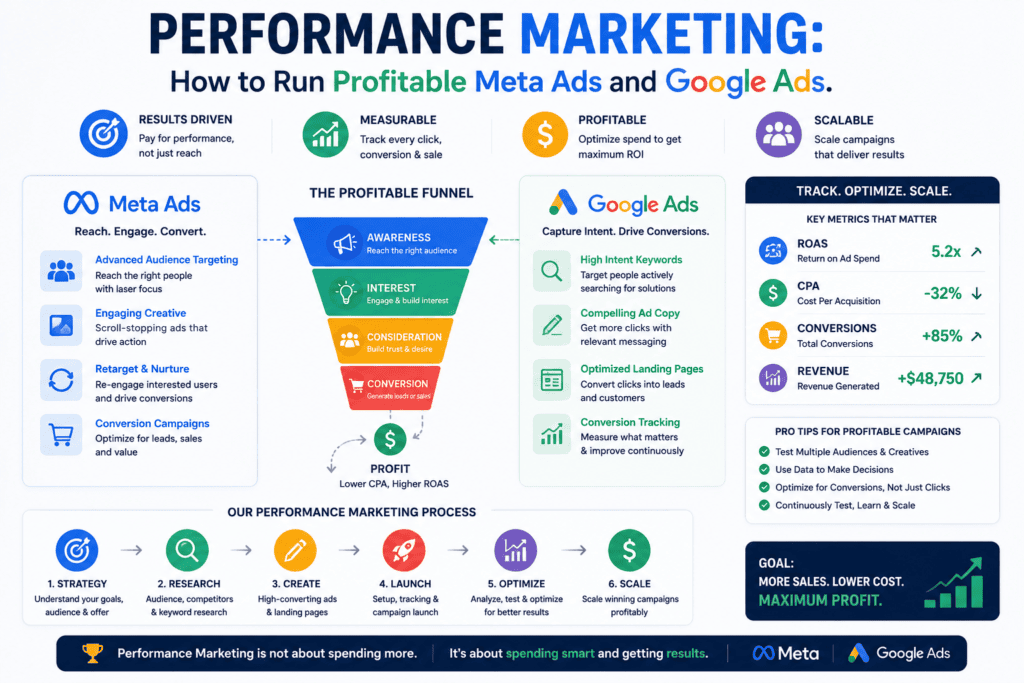
Platforms like Meta Ads (Facebook and Instagram) and Google Ads have become essential tools for businesses looking to reach highly targeted audiences. These platforms allow advertisers to pay for measurable actions, ensuring that marketing budgets are spent efficiently.
However, launching ads alone is not enough. To build profitable campaigns, marketers must understand important performance metrics such as Return on Ad Spend (ROAS), Customer Acquisition Cost (CAC), and Customer Lifetime Value (CLV or LTV). These metrics help businesses evaluate profitability and make informed marketing decisions.
In this article, we’ll explore what performance marketing is, how Meta Ads and Google Ads work, and how to use key performance metrics to maximize your advertising success.
What Is Performance Marketing?
Performance marketing is a digital advertising strategy where businesses pay based on measurable results rather than simply paying for exposure.
These measurable results may include:
- Website visits
- Leads
- Product purchases
- Phone calls
- App downloads
- Newsletter sign-ups
- Form submissions
Every campaign is tracked using analytics tools, allowing marketers to continuously improve performance and reduce wasted spending.
Unlike traditional advertising methods, performance marketing provides real-time data that enables quick optimization.
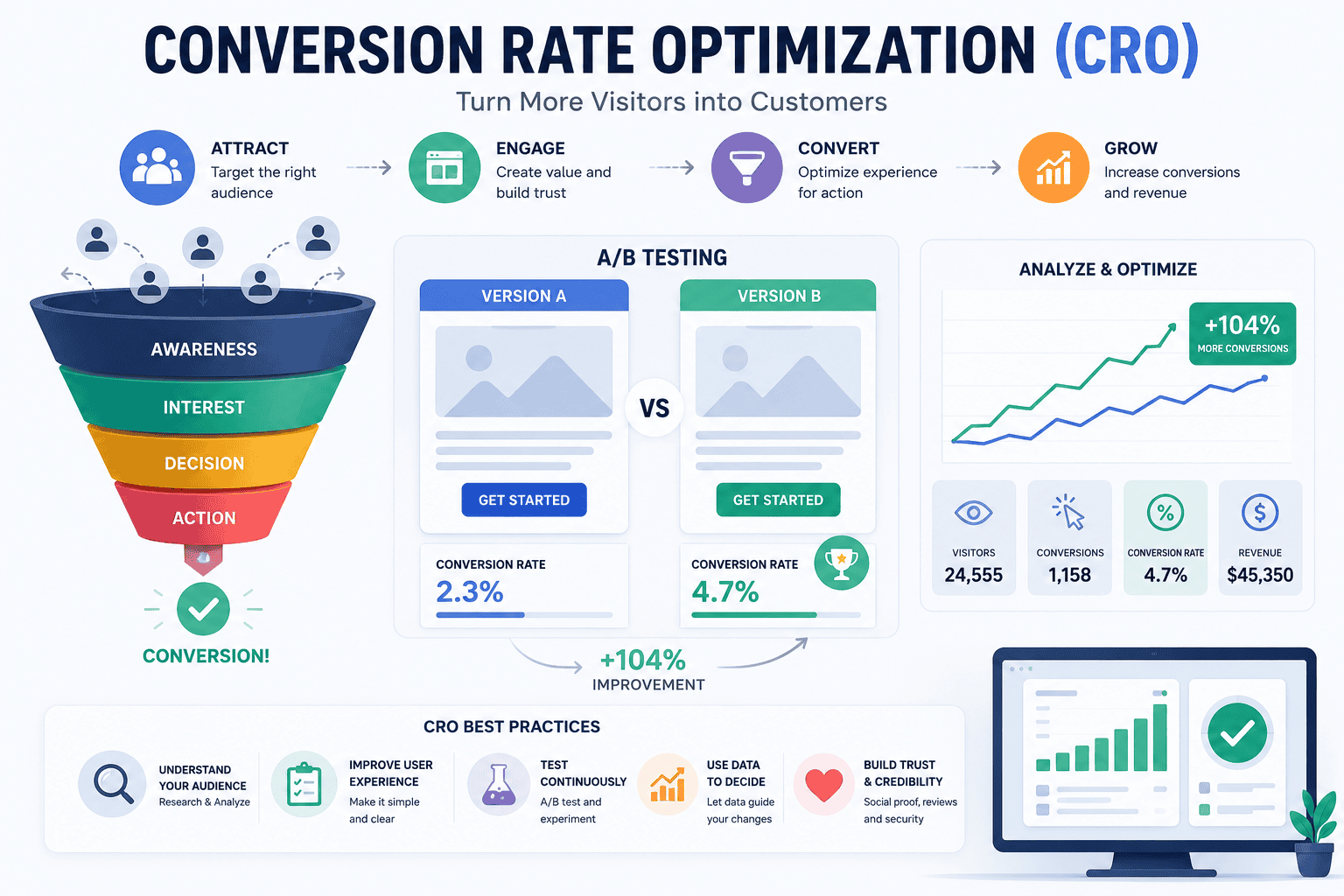
Why Performance Marketing Matters
Performance marketing offers several important advantages.
Measurable Results
Every click, impression, conversion, and sale can be tracked.
Businesses know exactly how much revenue each campaign generates.
Better Budget Control
Advertisers can set daily or monthly budgets and adjust spending based on campaign performance.
This flexibility makes performance marketing suitable for both small businesses and large enterprises.
Highly Targeted Advertising
Modern advertising platforms allow businesses to target audiences based on:
- Age
- Gender
- Location
- Interests
- Online behavior
- Purchase history
- Search intent
Better targeting increases conversion rates while reducing unnecessary spending.
Continuous Optimization
Campaigns can be improved by testing:
- Headlines
- Images
- Videos
- Audiences
- Landing pages
- Ad copy
- Calls-to-action
Small improvements often lead to significantly better results over time.
Running Profitable Meta Ads
Meta Ads allow businesses to advertise across Facebook, Instagram, Messenger, and the Meta Audience Network.
These platforms are particularly effective for:
- Brand awareness
- Lead generation
- E-commerce sales
- Event promotion
- Local businesses
- Service providers
Choose the Right Campaign Objective
Meta Ads Manager offers several campaign objectives.
Common objectives include:
- Brand Awareness
- Traffic
- Engagement
- Leads
- App Promotion
- Sales
Choosing the correct objective helps Meta optimize delivery for your business goals.
Target the Right Audience
Meta provides advanced audience targeting options.
You can target users based on:
- Demographics
- Interests
- Behaviors
- Custom audiences
- Website visitors
- Email subscribers
- Lookalike audiences
Accurate audience targeting is one of the biggest factors influencing campaign profitability.
Create Compelling Ad Creatives
Successful Meta Ads usually include:
- High-quality images or videos
- Clear headlines
- Strong value propositions
- Simple messaging
- Clear call-to-action buttons
Visual content often determines whether users stop scrolling and engage with your advertisement.
Monitor Campaign Performance
Regularly analyze:
- Click-through rate (CTR)
- Cost per click (CPC)
- Conversion rate
- Cost per lead
- Return on Ad Spend (ROAS)
Optimization should be an ongoing process rather than a one-time activity.
Running Profitable Google Ads
Google Ads help businesses reach users who are actively searching for products or services.
Unlike social media advertising, search advertising targets users with immediate purchase intent.
Choose Relevant Keywords
Keyword selection is one of the most important aspects of Google Ads.
Focus on keywords that indicate buying intent.
Examples include:
- Buy running shoes online
- SEO agency in Delhi
- Emergency plumber near me
- Best accounting software
Avoid targeting overly broad keywords that attract unqualified traffic.
Write Effective Ad Copy
Successful Google Ads typically include:
- Relevant keywords
- Clear benefits
- Strong calls-to-action
- Unique selling points
- Trust-building information
Well-written advertisements improve click-through rates and Quality Scores.
Optimize Landing Pages
Google Ads perform best when visitors arrive on highly relevant landing pages.
Landing pages should include:
- Matching headlines
- Clear messaging
- Fast loading speed
- Mobile responsiveness
- Simple forms
- Strong calls-to-action
The better the landing page experience, the higher the conversion rate.
Improve Quality Score
Google rewards advertisers with relevant advertisements.
Quality Score depends on:
- Keyword relevance
- Ad relevance
- Landing page quality
- Expected click-through rate
Higher Quality Scores often reduce advertising costs while improving ad positions.
Understanding ROAS (Return on Ad Spend)
ROAS measures how much revenue your advertising generates for every dollar or rupee spent.
The basic formula is:
ROAS = Revenue Generated ÷ Advertising Cost
For example:
- Advertising Cost: $500
- Revenue Generated: $2,500
ROAS = 5
This means every $1 spent on advertising generates $5 in revenue.
A higher ROAS generally indicates a more profitable campaign.
However, businesses should also consider operating costs before evaluating profitability.
Understanding CAC (Customer Acquisition Cost)
Customer Acquisition Cost measures how much it costs to acquire one new customer.
The basic formula is:
CAC = Total Marketing and Sales Cost ÷ Number of New Customers
Example:
- Marketing Cost: $2,000
- New Customers: 100
CAC = $20
This means the business spends $20 to acquire each new customer.
Reducing CAC while maintaining quality customers improves overall business profitability.
Understanding Customer Lifetime Value (CLV)
Customer Lifetime Value estimates how much revenue a customer generates throughout their entire relationship with your business.
Factors influencing CLV include:
- Purchase frequency
- Average order value
- Customer retention
- Subscription length
- Repeat purchases
Businesses with high Customer Lifetime Value can often afford higher acquisition costs because customers continue generating revenue over time.
For example, a customer who spends $500 over several years is significantly more valuable than one who makes a single $50 purchase.
Balancing ROAS, CAC, and CLV
Successful performance marketers evaluate these three metrics together rather than independently.
For example:
A campaign may have:
- High CAC
- High CLV
Even though acquiring customers is expensive, long-term profitability remains strong because customers continue making purchases.
Similarly:
High ROAS combined with low customer retention may not produce sustainable growth.
The goal is to maximize lifetime profitability rather than focusing on one metric alone.
Best Practices for Performance Marketing
To improve campaign performance:
- Clearly define campaign goals.
- Install accurate conversion tracking.
- Test multiple ad creatives.
- Optimize landing pages regularly.
- Use audience segmentation.
- Continuously monitor campaign data.
- Pause underperforming ads.
- Scale successful campaigns gradually.
Successful advertisers rely on data rather than assumptions.
Common Performance Marketing Mistakes
Many businesses waste advertising budgets due to avoidable mistakes.
Common errors include:
- Targeting the wrong audience.
- Ignoring conversion tracking.
- Sending traffic to poor landing pages.
- Failing to test different advertisements.
- Making optimization decisions too quickly.
- Focusing only on clicks instead of conversions.
- Ignoring Customer Lifetime Value.
Avoiding these mistakes can dramatically improve campaign profitability.
The Future of Performance Marketing
Artificial intelligence is transforming performance marketing. Platforms like Google Ads and Meta Ads increasingly use AI to automate bidding, optimize audience targeting, generate ad creatives, and predict campaign performance. Marketers also have access to advanced analytics, predictive modeling, and automated budget allocation, allowing them to make faster and more informed decisions.
At the same time, growing privacy regulations and the decline of third-party cookies are encouraging businesses to rely more on first-party data and customer relationships. Companies that combine AI-powered automation with strong creative strategies and ethical data practices will be best positioned for long-term success.
Conclusion
Performance marketing enables businesses to achieve measurable growth by focusing on real business outcomes rather than simply generating impressions or clicks. Platforms like Meta Ads and Google Ads provide powerful opportunities to reach highly targeted audiences, generate qualified leads, and increase sales.
However, long-term success depends on more than launching campaigns. Marketers must continuously analyze performance using key metrics such as ROAS, Customer Acquisition Cost (CAC), and Customer Lifetime Value (CLV). By optimizing advertisements, improving landing pages, refining audience targeting, and making data-driven decisions, businesses can maximize profitability and build sustainable digital marketing strategies that deliver consistent results.
