Introduction
Search is evolving faster than ever. For years, businesses focused on Search Engine Optimization (SEO) to rank on Google’s search results pages. Today, artificial intelligence is transforming how people discover information. Instead of clicking through a list of blue links, users are increasingly asking AI assistants like ChatGPT, Google AI Mode, Gemini, and Perplexity direct questions and receiving conversational answers.
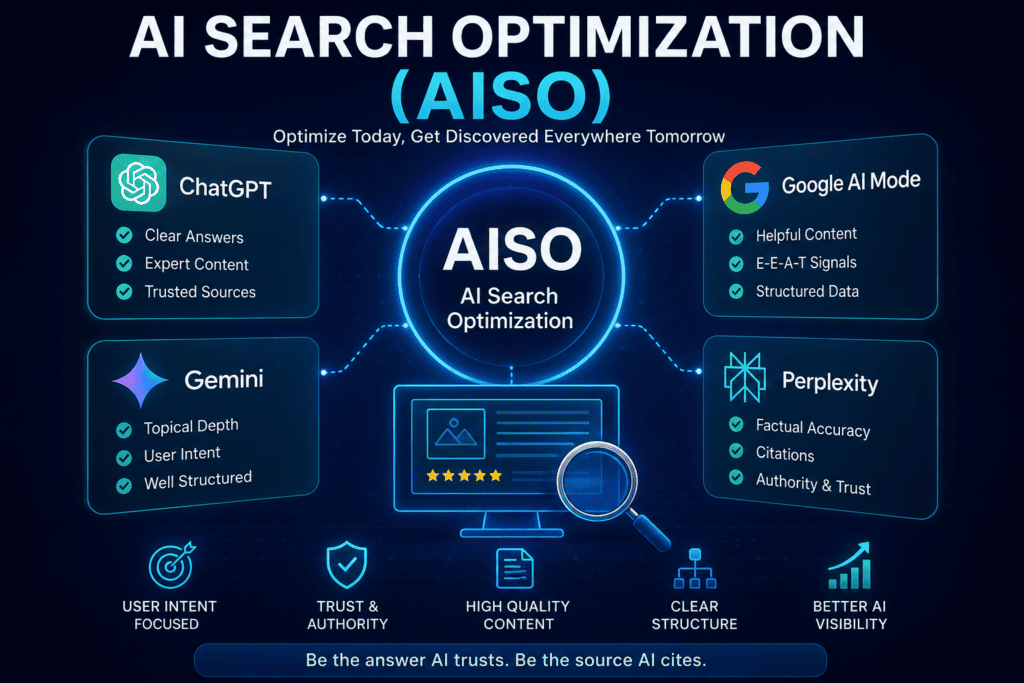
This shift has created a new discipline known as AI Search Optimization (AISO). Rather than optimizing only for search engine rankings, businesses now need to optimize their content so AI systems can understand, trust, and cite it when generating answers.
In this article, you’ll learn what AISO is, how it differs from traditional SEO, and practical strategies to improve your visibility in AI-powered search platforms.
What Is AI Search Optimization (AISO)?
AI Search Optimization (AISO) is the process of creating and optimizing content so that AI-powered search assistants can discover, understand, and reference it in their responses.
Unlike traditional search engines that rank web pages based on hundreds of ranking signals, AI assistants generate answers by combining information from trusted websites, structured data, authoritative sources, and their own language models.
The goal is no longer just to rank #1 on Google. The goal is to become one of the sources AI trusts enough to mention or summarize.
Traditional SEO vs AI Search Optimization(AISO)
Although AI Search Optimization builds on many SEO principles, there are important differences.
| Traditional SEO | AI Search Optimization |
|---|---|
| Focuses on ranking web pages | Focuses on being referenced by AI assistants |
| Optimizes keywords | Optimizes topics and user intent |
| Success measured by rankings | Success measured by AI mentions and citations |
| Encourages click-throughs | Encourages trustworthy answers and authority |
| Relies heavily on backlinks | Relies on authority, expertise, and content quality |
| Targets search engine algorithms | Targets AI language models and retrieval systems |
Traditional SEO is still important because AI assistants often retrieve information from well-optimized websites. However, keyword stuffing and outdated SEO tactics are becoming less effective in an AI-first search environment.
How AI Search Platforms Work
Most AI Search Optimization (AISO) platforms follow a similar process:
- Understand the user’s question.
- Search trusted sources for relevant information.
- Evaluate the credibility and usefulness of those sources.
- Generate a concise, conversational answer.
- Sometimes provide citations or links to the original websites.
This means your content needs to be accurate, easy to understand, and well-structured.
How to Rank in ChatGPT
ChatGPT may use trusted web sources when answering certain questions, especially when web browsing is available. To improve your chances of being referenced:
- Publish original, high-quality content.
- Cover topics in depth instead of writing shallow articles.
- Demonstrate real expertise.
- Include factual information supported by reliable sources.
- Use clear headings and logical structure.
- Build your website’s overall authority.
Content that answers common questions clearly has a higher chance of being surfaced.
How to Rank in Google AI Mode
Google AI Mode builds upon Google’s existing search systems while generating AI-powered summaries.
To improve visibility:
- Continue following SEO best practices.
- Write comprehensive articles that fully answer search intent.
- Add structured headings and schema markup where appropriate.
- Improve page speed and mobile usability.
- Demonstrate Experience, Expertise, Authoritativeness, and Trustworthiness (E-E-A-T).
- Keep content regularly updated.
Google rewards websites that consistently publish reliable and helpful information.
How to Rank in Gemini
Gemini benefits from content that is well-organized and easy to interpret.
Best practices include:
- Use descriptive headings.
- Explain concepts clearly.
- Break long paragraphs into smaller sections.
- Include examples and practical insights.
- Answer related questions within the same article.
Well-structured educational content performs particularly well.
How to Rank in Perplexity
Perplexity frequently cites websites directly in its answers, making it especially important to publish trustworthy content.
Improve your chances by:
- Publishing research-backed articles.
- Citing reputable sources.
- Writing comprehensive guides.
- Updating outdated information.
- Covering topics thoroughly rather than briefly.
Perplexity tends to favor websites with strong credibility and factual accuracy.
Best Practices for AI Search Optimization (AISO)
Focus on User Intent
Instead of targeting a single keyword repeatedly, answer the complete question users are asking.
For example:
Poor approach:
“Best digital marketing agency Delhi”
Better approach:
“How do I choose the best digital marketing agency in Delhi for my business?”
Natural language aligns better with AI systems.
Create Topic Clusters
Rather than publishing unrelated articles, build groups of interconnected content around one subject.
For example, a digital marketing website could create articles about:
- SEO basics
- Local SEO
- Technical SEO
- AI Search Optimization (AISO)
- Google Business Profile
- Content Marketing
This helps establish topical authority.
Write Like You’re Teaching Someone
AI systems prefer content that is clear and easy to understand.
Use:
- Simple language
- Definitions
- Examples
- Step-by-step explanations
- Bullet points where appropriate
Avoid unnecessary jargon unless your audience expects it.
Build Trust
AI assistants prioritize trustworthy information.
Ways to build trust include:
- Display author information.
- Keep facts updated.
- Link to reputable references when appropriate.
- Avoid exaggerated claims.
- Provide accurate statistics.
Trust is becoming just as important as keywords.
Use Clear Structure
Organize every article using:
- H1 title
- H2 sections
- H3 subsections
- Short paragraphs
- Lists and tables where helpful
A clear structure makes content easier for both readers and AI systems to understand.
Common Mistakes to Avoid
Many websites still rely on outdated SEO practices that are less effective today.
Avoid:
- Keyword stuffing
- Publishing thin or duplicate content
- Using misleading clickbait headlines
- Ignoring user intent
- Creating content solely for search engines instead of readers
- Neglecting updates to older articles
High-quality, user-focused content consistently outperforms low-value pages.
The Future of AI Search
AI-powered search will continue to evolve. As users increasingly rely on conversational assistants, businesses that adapt early will have a competitive advantage.
Future optimization will likely place even greater emphasis on:
- Original research
- Expert insights
- Real-world experience
- High-quality multimedia
- Structured and trustworthy content
Instead of asking, “How do I rank higher?” marketers should ask, “How can I provide the best answer?”
That mindset is at the heart of AI Search Optimization.
Conclusion
AI Search Optimization represents the next evolution of digital marketing. While traditional SEO remains essential, success in the AI era requires more than ranking for keywords. It requires creating authoritative, well-structured, and genuinely helpful content that AI platforms can confidently reference.
Whether your audience is using ChatGPT, Google AI Mode, Gemini, or Perplexity, the objective is the same: become the most reliable source of information. By focusing on user intent, topical authority, trustworthiness, and clear communication, you can improve your visibility not only in search engines but also in the AI-powered experiences that are shaping the future of online search.
:%20Proven%20Strategies%20to%20Dominate%20ChatGPT,%20Google%20AI%20Mode,%20Gemini,%20and%20Perplexity)