Introduction
Programmatic SEO is a strategy that combines data, templates, and automation to generate large numbers of search engine optimized pages efficiently. Instead of creating every page manually, businesses build reusable page templates that automatically populate content using structured data.
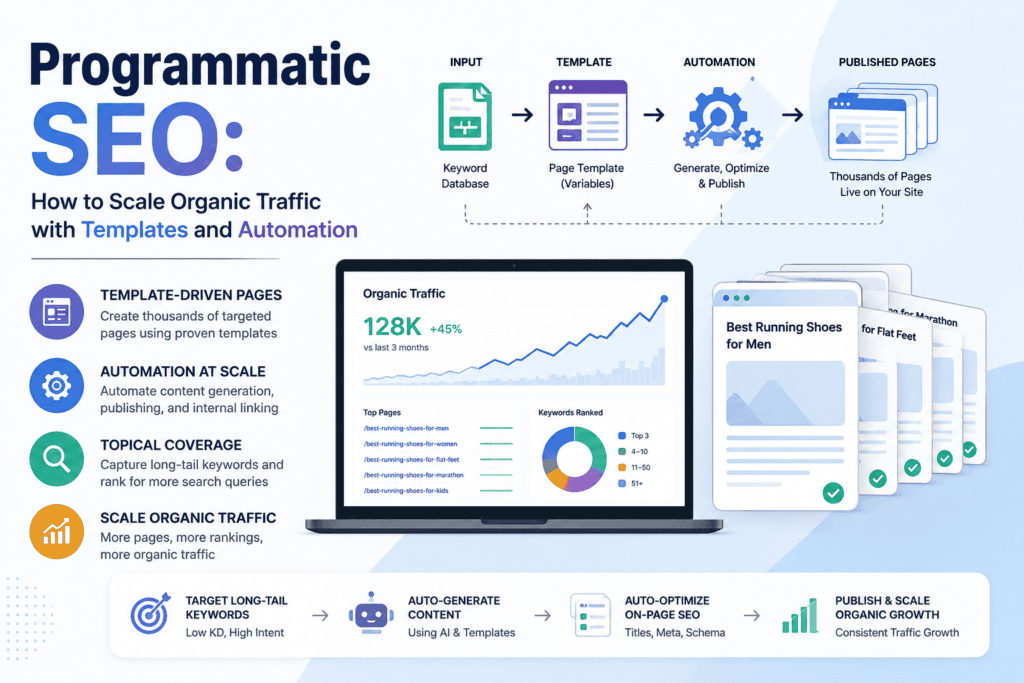
Creating high-quality content for search engines can be time-consuming, especially for websites targeting thousands of keywords. Writing individual pages manually may work for small websites, but it becomes inefficient when you need hundreds or even thousands of pages. This is where Programmatic SEO (pSEO) comes into play.
Many of the world’s largest websites—including travel platforms, real estate portals, job boards, business directories, and e-commerce marketplaces—use Programmatic SEO to attract millions of visitors through organic search. When implemented correctly, Programmatic SEO allows businesses to scale content production while maintaining quality and relevance.
In this article, you’ll learn what Programmatic SEO is, how it works, its benefits, ideal use cases, best practices, and common mistakes to avoid.
What Is Programmatic SEO?
Programmatic SEO (pSEO) is the process of automatically creating large numbers of SEO-friendly webpages using structured data, templates, and automation.
Instead of writing each webpage individually, businesses design a page layout that pulls information from a database or spreadsheet to generate unique pages for different search queries.
For example, instead of manually creating pages for:
- SEO Agency in Delhi
- SEO Agency in Mumbai
- SEO Agency in Bangalore
- SEO Agency in Chennai
A single template can automatically generate hundreds of location-specific pages using city names stored in a database.
This approach saves time while allowing websites to target thousands of long-tail keywords.
How Programmatic SEO Works
Programmatic SEO generally follows four main steps.
Step 1: Collect Structured Data
The process begins by gathering organized data that will populate your pages.
Examples include:
- City names
- Product information
- Business listings
- Hotel data
- Salary information
- Currency exchange rates
- Educational courses
- Software comparisons
The more accurate and complete your data, the better your pages will be.
Step 2: Create a Page Template
Next, you design a reusable webpage template.
The template usually includes:
- Page title
- Headings
- Images
- Descriptions
- Internal links
- FAQs
- Call-to-action
- Metadata
Dynamic placeholders automatically insert relevant information for each page.
Step 3: Generate Multiple Pages
Using automation, your content management system creates hundreds or thousands of pages by replacing placeholders with actual data.
For example:
Template:
“Best Digital Marketing Agency in {City}”
Automatically becomes:
- Best Digital Marketing Agency in Delhi
- Best Digital Marketing Agency in Pune
- Best Digital Marketing Agency in Hyderabad
Each page targets a unique search intent while maintaining a consistent design.
Step 4: Optimize for SEO
Finally, every generated page should include SEO best practices such as:
- Unique title tags
- Meta descriptions
- Internal links
- Image optimization
- Schema markup
- Fast loading speed
- Mobile responsiveness
Automation handles repetitive tasks while ensuring consistency across all pages.
Benefits of Programmatic SEO
Scale Content Quickly
The biggest advantage of Programmatic SEO is scalability.
Instead of publishing ten pages per month, businesses can create hundreds or even thousands of pages in a relatively short time.
This allows websites to target many more search queries.
Target Long-Tail Keywords
Long-tail keywords often have lower competition and higher conversion rates.
Examples include:
- Best dentist in South Delhi
- Hotels near Mumbai Airport
- Digital marketing course in Bangalore
Programmatic SEO makes it possible to target thousands of these specific search terms efficiently.
Save Time and Resources
Manually writing thousands of pages requires enormous effort.
Automation reduces repetitive work while allowing content teams to focus on improving quality and strategy.
Increase Organic Traffic
Each optimized page has the potential to rank for unique search queries.
As more pages become indexed, websites can attract significantly more organic visitors.
Many successful websites generate millions of monthly visits using Programmatic SEO.
Improve User Experience
Users appreciate finding highly specific pages that directly answer their questions.
Instead of visiting a generic page, they find information tailored to their location, product, or search intent.
Ideal Use Cases for Programmatic SEO
Programmatic SEO works best for websites containing structured, repeatable information.
Business Directories
Directories often generate pages for:
- Restaurants
- Hotels
- Doctors
- Lawyers
- Schools
- Service providers
Each listing becomes an optimized landing page targeting local searches.
Location-Based Websites
Businesses operating in multiple cities can create dedicated pages for every service area.
Examples include:
- SEO Services in Delhi
- SEO Services in Mumbai
- SEO Services in Kolkata
Each page can include city-specific information while maintaining the same template.
Online Calculators
Financial and educational websites frequently use Programmatic SEO for calculators.
Examples include:
- EMI Calculator
- BMI Calculator
- Loan Calculator
- GST Calculator
- Age Calculator
- Percentage Calculator
Each calculator targets valuable search traffic.
E-commerce Websites
Online stores often generate thousands of pages for:
- Product categories
- Brands
- Colors
- Sizes
- Models
Automation helps organize large inventories while improving search visibility.
Travel Websites
Travel platforms create pages for:
- Hotels
- Flights
- Tourist attractions
- Travel guides
- Airport information
These pages attract highly targeted visitors planning trips.
Best Practices for Programmatic SEO
Ensure Every Page Provides Value
One of the biggest mistakes in Programmatic SEO is creating pages that contain little useful information.
Every page should include:
- Unique descriptions
- Helpful information
- Images
- FAQs
- Internal links
- Relevant recommendations
Quality should never be sacrificed for quantity.
Avoid Duplicate Content
Search engines dislike duplicate or nearly identical pages.
Each generated page should contain unique elements beyond simply changing a city or product name.
Adding location-specific content, statistics, customer reviews, or recommendations improves uniqueness.
Use Structured Data
Schema markup helps search engines understand page content.
Useful schema types include:
- Local Business
- Product
- FAQ
- Review
- Article
- Organization
Structured data can improve search visibility and rich results.
Optimize Internal Linking
Programmatic websites often contain thousands of pages.
Strong internal linking helps users navigate while assisting search engines in discovering new pages.
Link related pages naturally wherever possible.
Monitor Page Performance
Not every generated page will perform equally well.
Track important metrics such as:
- Organic traffic
- Keyword rankings
- Bounce rate
- Click-through rate
- Conversion rate
Regular analysis helps identify pages that need improvement.
Common Mistakes to Avoid
Programmatic SEO can produce poor results if implemented incorrectly.
Avoid these common mistakes:
- Publishing thin content.
- Creating thousands of nearly identical pages.
- Ignoring search intent.
- Automating low-quality content.
- Using inaccurate or outdated data.
- Neglecting mobile optimization.
- Forgetting technical SEO fundamentals.
Search engines reward helpful content—not simply large quantities of pages.
Tools for Programmatic SEO
Several tools simplify Programmatic SEO workflows.
Popular options include:
- Google Sheets for managing structured data.
- Airtable for organizing databases.
- WordPress with dynamic content plugins.
- Webflow CMS.
- Next.js and React for dynamic websites.
- Python scripts for automation.
- Zapier for workflow automation.
- AI writing tools for generating supporting content.
Combining automation with human oversight produces the best results.
The Future of Programmatic SEO
As artificial intelligence continues to evolve, Programmatic SEO is becoming even more powerful. AI can assist with generating unique descriptions, improving page quality, optimizing metadata, and identifying keyword opportunities at scale.
However, search engines are increasingly focused on rewarding helpful, original, and user-focused content. Simply generating thousands of pages is no longer enough. Future success will depend on combining automation with valuable information, strong user experience, accurate data, and high-quality content that genuinely answers user queries.
Businesses that balance scalability with quality will continue to benefit from Programmatic SEO while maintaining long-term search visibility.
Conclusion
Programmatic SEO is a highly effective strategy for businesses that need to create hundreds or thousands of search-optimized webpages efficiently. By combining structured data, reusable templates, and automation, companies can target a wide range of long-tail keywords without manually building every page.
This approach is especially valuable for business directories, calculators, e-commerce platforms, travel websites, and location-based businesses. However, successful Programmatic SEO is not about producing the largest number of pages—it is about delivering useful, accurate, and unique content that satisfies user intent.
When implemented with thoughtful planning, strong technical SEO, and a focus on quality, Programmatic SEO can become one of the most powerful methods for increasing organic traffic, improving search visibility, and driving long-term business growth.
